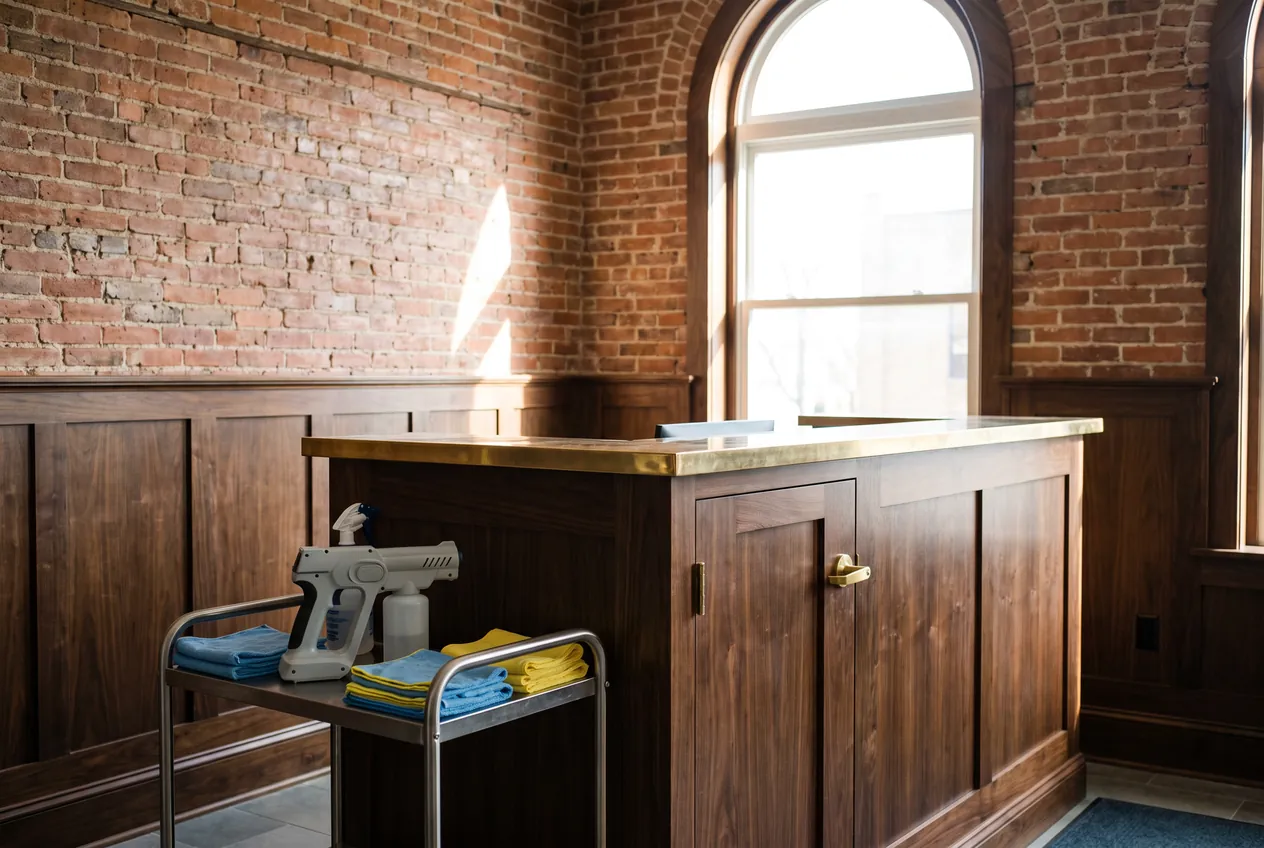
Disinfecting is the second step, never the first. Dust, body oils and grime on a surface shield whatever is underneath, so the crew cleans with a detergent first and only then applies the disinfectant. Every disinfectant sold in the United States is registered with the EPA, and its label lists the surfaces it is meant for and a contact time, also called dwell time. That is the number of minutes the surface has to stay visibly wet for the product to work as labeled.
Most disinfection that falls short does so on timing. A quick spray and an immediate wipe looks like a thorough job, but the surface was wet for seconds instead of minutes. Electrostatic sprayers put a charge on the droplets so they wrap around chair arms, handles and keypads, which is useful in large rooms. They still have to follow the label contact time, and they do not replace the cleaning step. A good crew plans its route so surfaces sit wet long enough before anyone touches them.
Scheduled workplace disinfection and biohazard cleanup are two separate trades. Blood or bodily fluid spills beyond the everyday, crime or trauma scenes, and sewage backups are handled by specialist remediation companies with their own training, protective equipment and disposal requirements. A janitorial provider is the right call for scheduled disinfection of offices, clinics, gyms and schools. When you request a quote, list the rooms and touch points that matter most and ask which products and contact times the crew will use.
Where disinfection fits in Louisville workplaces
Louisville has a large healthcare sector, and clinics, dental offices and outpatient suites around the city are among the buildings that most often add regular disinfection to their cleaning plans. The same approach carries over to other busy spaces: shared offices downtown, suburban parks in Jeffersontown and Middletown, and schools, gyms and retail across Jefferson County and Southern Indiana. Wet, cold winters keep people indoors with doors closed and the heat running, so touch points such as entry push bars, elevator buttons and break room handles see constant contact for months at a stretch.
Most Louisville buildings schedule disinfection as part of the nightly or after-hours visit, so treated surfaces can stay wet for the full contact time without people touching them. Facilities open long hours, such as medical offices and fitness spaces, sometimes add a daytime pass on restrooms and front desks. Offices in New Albany, Clarksville and St. Matthews often add extra visits during the winter months.
What changes the price of disinfection service in Louisville
- Number of touch points
- A building with many restrooms, shared workstations and door hardware has more surfaces to treat than an open floor of the same size, and that drives the time involved.
- Method used
- Hand application with wipes and spray bottles suits detail work, while electrostatic equipment speeds up large rooms. Many plans combine both, and the mix shapes labor and equipment needs.
- Frequency and timing
- Disinfection at every nightly visit costs differently than a weekly or monthly treatment. Daytime passes during business hours add another layer on top of the after-hours work.
- Type of facility
- Clinics, gyms and childcare spaces often need more surfaces treated and more careful product choices than a standard office, which adds steps and time to each visit.
How a typical disinfection schedule is laid out
| What gets done | How frequently |
|---|---|
| Restroom fixtures, handles and dispensers | At every visit |
| Door handles, push plates and switches | At every visit |
| Break room counters and appliance handles | At every visit |
| Shared phones, keyboards and keypads | Daily to weekly, by request |
| Electrostatic treatment of larger rooms | Weekly to monthly, as needed |
| Railings and elevator buttons | Daily in busy buildings |
Think of this as a sensible place to begin rather than a set plan, since the provider will fine-tune it after walking through your space and hearing how your staff make use of it.
What the service typically covers
- Cleaning surfaces before applying disinfectant
- EPA-registered products used per label
- Full contact time on treated surfaces
- Door handles, push plates and light switches
- Restroom fixtures, stalls and dispensers
- Break room counters and appliance handles
- Electrostatic spraying where it suits the space
- A written list of treated touch points
You and the provider settle the specific tasks and timing together when they prepare a quote for your space.
Neighborhoods we hear from
Businesses throughout the Louisville area send us disinfection requests, from Downtown Louisville, St. Matthews, The Highlands, Jeffersontown, Middletown, Hurstbourne and beyond. See all areas.
More cleaning services in Louisville
- Commercial Cleaning in Louisville
- Office Cleaning in Louisville
- Janitorial Services in Louisville
- Medical Office Cleaning in Louisville
- Floor Care in Louisville
- Post-Construction Cleaning in Louisville
- Day Porter Services in Louisville
- Commercial Carpet Cleaning in Louisville
- Commercial Window Cleaning in Louisville