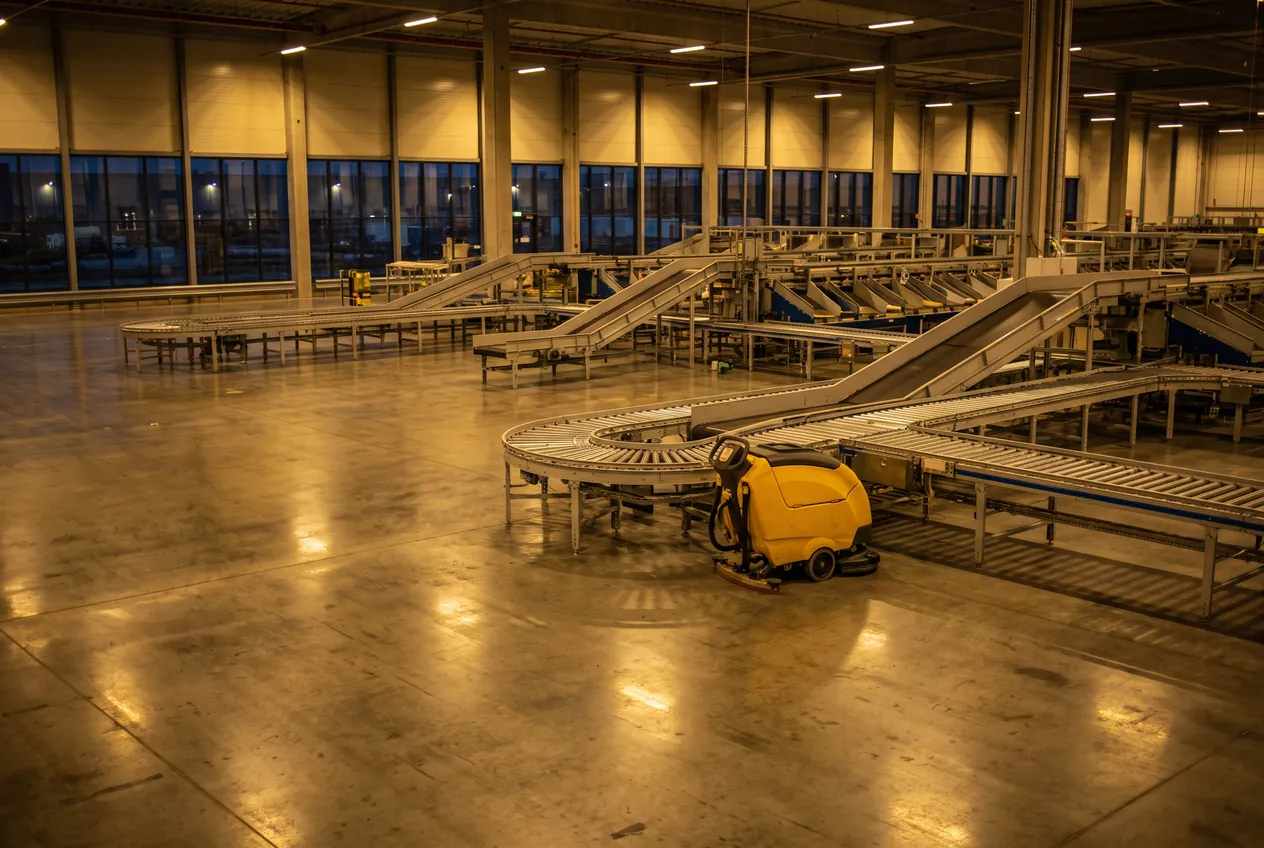
Most of the square footage is open concrete, sealed or bare, and it is cleaned with machines rather than mops. A ride-on sweeper picks up dust, grit, pallet splinters and bits of strapping, and an auto scrubber follows with water and cleaner and pulls the dirty solution back up so the floor dries quickly. Aisles between racking are swept on a set rotation, and spots where drips or tire marks build up get scrubbed more often. Inside the building, the offices, break rooms, restrooms and locker rooms are cleaned on a normal janitorial schedule, since that is where staff notice the difference.
Dock areas collect more than any other part of the building. Leaves, mud, shrink wrap, broken pallet boards and road grit come in with every trailer, and that debris tracks deep into the floor if it is left. High dusting is a separate, less frequent job: racking tops, beams, light fixtures and HVAC returns are reached from lifts by trained operators, usually with the area below blocked off. Because forklifts and people share the floor, the crew follows the site's safety rules, wears the required PPE and works only in zones the warehouse has cleared.
One mistake is treating floor cleaning as appearance only. Federal workplace safety rules from OSHA expect walking and working surfaces to be kept clean, orderly and free of hazards, so loose debris, wrap and spills are a safety matter on a forklift floor. Another is skipping a plan for 24-hour buildings. In those, cleaning goes zone by zone, with the warehouse telling the crew which aisles and docks are open at which hours. A third is never scheduling high dusting until dust visibly falls on stock.
Keeping Louisville warehouse floors and docks under control through the seasons
In Louisville, warehouse floors feel the weather mostly at the docks. Wet, cold winters push slush, mud and road grit off every trailer and onto the concrete, where forklift tires carry it down the aisles and leave the floor slick and gritty. Humid summers can leave condensation on concrete near open dock doors and make dust cling to surfaces. Buildings in Okolona and Shively, and those across the river in Jeffersonville and Clarksville, often see heavy truck traffic, so a floor plan that steps up dock and entry cleaning in the wet months tends to hold up better than a fixed routine.
Most warehouses want floor machine work done when traffic is lightest, which can mean a second or third shift, a weekend window or a rotating zone plan in a building that never closes. Offices and break rooms are often cleaned in the evening, while high dusting is booked for a slow weekend so aisles can be blocked off. Requests come from distribution space in Okolona, Shively, Jeffersontown and Clarksville.
How a typical warehouse cleaning schedule is laid out
| What gets done | How frequently |
|---|---|
| Office, break room and restroom cleaning | Nightly to several times a week |
| Main floor ride-on sweeping | Daily to several times a week |
| Auto scrubbing of aisles and traffic lanes | Weekly to several times a week |
| Dock and loading area debris cleanup | Daily, more in wet months |
| Locker rooms cleaned and restocked | Daily or after each shift |
| High dusting of racking, beams and fixtures | Every 3 to 12 months |
Think of this as a sensible place to begin rather than a set plan, since the provider will fine-tune it after walking through your space and hearing how your staff make use of it.
What the service typically covers
- Ride-on sweeping of concrete floors
- Auto scrubbing of aisles and lanes
- Dock and loading area cleanup
- Shrink wrap and pallet debris removal
- Office and break room cleaning
- Restrooms and locker rooms cleaned and restocked
- High dusting from lifts by trained operators
- Trash and recycling to site dumpsters
You and the provider settle the specific tasks and timing together when they prepare a quote for your space.
What sets the cost of warehouse cleaning in Louisville
- Floor area and condition
- Total square footage drives machine time, and a floor with built-up grime, tire marks or old spills needs a heavier first scrub before routine cleaning can keep up.
- Operating hours
- A building that runs around the clock needs zone-by-zone cleaning around live traffic, which takes more planning and often more crew hours than a site that closes at night.
- High dusting needs
- Racking height, the number of beams and fixtures, and whether lifts must be brought in all affect the cost of overhead dusting, which is usually quoted on its own.
- Office and amenity space
- The size of the offices, break rooms, restrooms and locker rooms adds regular janitorial time on top of floor work, especially with several shifts using them.
Related services in Louisville
- Floor Care in Louisville
- Janitorial Services in Louisville
- Day Porter Services in Louisville
- Post-Construction Cleaning in Louisville
Cleaning for other types of business in Louisville
- Restaurant Cleaning in Louisville
- Church Cleaning in Louisville
- School and Daycare Cleaning in Louisville
Neighborhoods we hear from
Businesses throughout the Louisville area send us warehouse cleaning requests, from Downtown Louisville, St. Matthews, The Highlands, Jeffersontown, Middletown, Hurstbourne and beyond. See all areas.