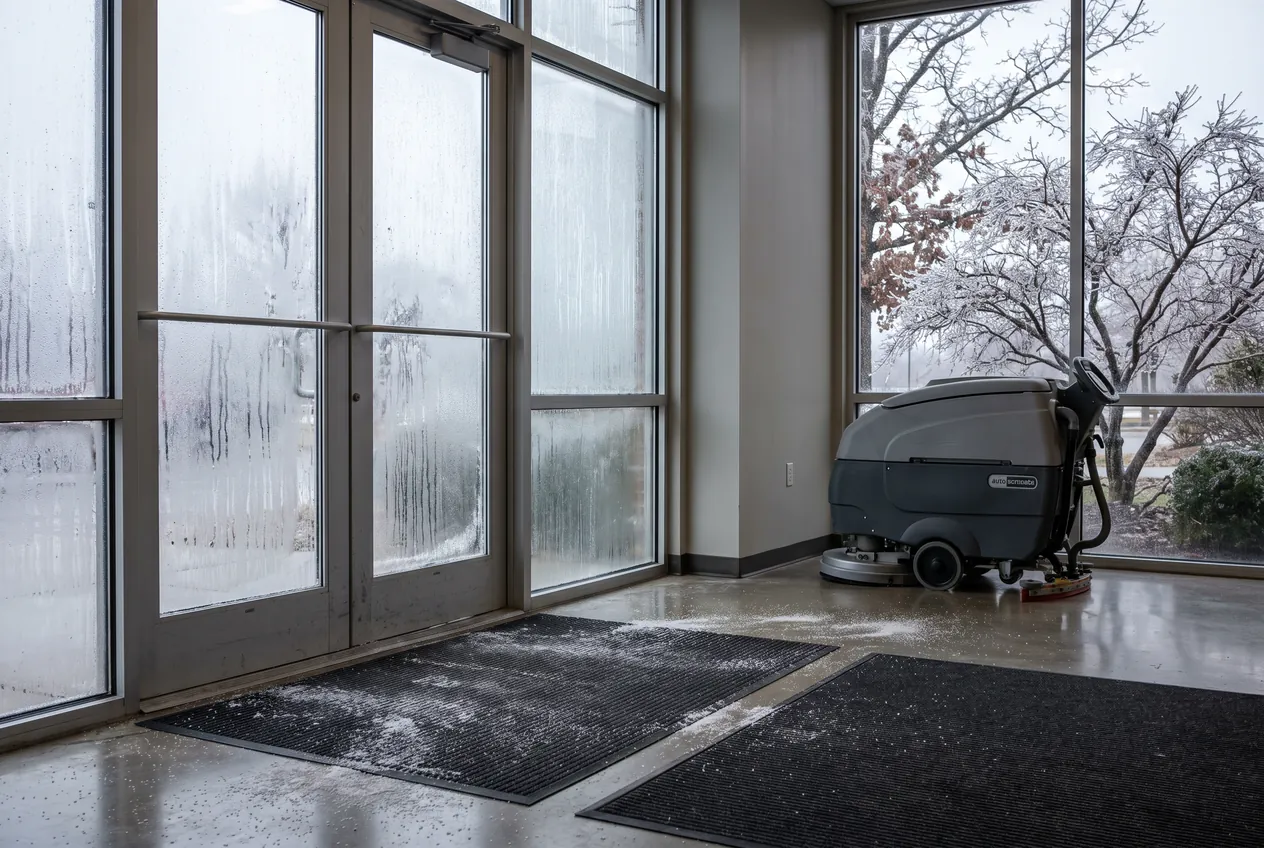
What ice melt does to commercial floors
Rock salt and the calcium chloride and magnesium chloride ice melts used on walkways all leave the same calling card indoors: a white, chalky film that dries on hard floors after every wet footprint. On tile with a floor finish, that film dulls the shine and wears at the finish each time it is walked on. It also makes floors slippery, which is a safety problem as much as a cleaning one.
Carpet suffers differently. Salt water soaks into the fibers and dries into pale rings and tide marks, and the residue attracts more dirt. Left alone over a winter, entry carpet can look permanently stained even when the damage can still be cleaned out.
Stop it at the door with a matting system
The cheapest salt to remove is the salt that never makes it past the entrance. A matting system works in stages: an outdoor scraper mat knocks off slush and grit, and indoor wiper mats absorb moisture and catch the fine residue. The indoor mats need to be long enough that people take several steps on them, since a single short mat only catches the first footprint.
Mats only work while they have room to hold more. A saturated mat starts tracking salt water across the floor instead of stopping it, so on wet days the mats need vacuuming, rotating or swapping as often as the entry floor itself. Ask whether the cleaning provider or a mat service handles that.
- Outdoor scraper mat at every public entrance
- Indoor wiper mats long enough for several steps
- Matting at the loading dock and staff entrances too
- Spare mats ready to swap when the first set is soaked
- Mats vacuumed daily and cleaned or replaced as they fill
- Edges flat and secured so they do not become trip hazards
A daily entry routine for ice melt season
Once walkways are being treated, the entry floor needs its own routine on top of regular cleaning. The goal is to remove grit before it scratches the finish and lift residue before it builds into a hard film. Over-wetting is the most common mistake, because a flooded floor just dissolves the salt and spreads it into grout lines and under the mats.
| Task | How often | Notes |
|---|---|---|
| Dust mop or vacuum entries | Daily, more on storm days | Removes grit before it is ground into the finish |
| Vacuum and rotate mats | Daily | Saturated mats track salt water inward |
| Damp mop with neutral or ice melt cleaner | Daily at entrances | Use little water and change it often |
| Auto scrub large lobbies | Daily or several times a week | Picks up dirty solution instead of leaving it to dry |
| Spot treat carpet near doors | As rings appear | Keeps residue from setting in |
| Check for slippery film | During each visit | Residue left to dry can be slick |
Getting salt film off tile and hard floors
Plain water moves salt around but does little to break up dried residue, and an alkaline all-purpose cleaner can make the film worse. A neutral cleaner, or a product made specifically for ice melt residue, does the job without damaging floor finish. Apply it with a damp mop or an auto scrubber, let it work briefly, and pick up the dirty solution rather than letting it air dry.
In large lobbies and long corridors, an auto scrubber is the right tool because it scrubs and vacuums in one pass, leaving the floor nearly dry. Grout lines on ceramic tile hold residue, so they may need a brush. On stone or specialty floors, follow the maker's care guidance before using any residue remover.
Removing salt rings from carpet
Vacuuming lifts loose salt crystals, but the rings left in entry carpet sit deeper in the fibers. Hot water extraction is the reliable fix: the machine flushes the residue out and pulls the water back up, which also keeps the carpet from staying damp. Spot treating with a product made for ice melt residue between extractions keeps the worst areas from setting in.
Plan at least one extraction of entry and corridor carpet as winter ends. If carpet near the doors stays stained through the season, the matting at that entrance is probably too short or too saturated. Fixing the matting before next winter costs less than repeated extractions.
Spring recovery for resilient floors
Even with good mats and a daily routine, a winter of salt and grit wears down the finish on VCT and other resilient floors near the entrances. A spring scrub and recoat deals with it: the crew deep scrubs the top layers of finish to remove embedded residue, rinses thoroughly and applies fresh coats. Floors worn through to bare tile may need a full strip instead.
Booking the spring visit in advance helps, because many buildings ask for the same work at the same time once the weather turns. Like any refinishing job, it is done after hours or on a weekend so the new finish can dry without traffic, and the entry mats go back down only once it has cured.
Salt and slush season in Louisville
Louisville's wet, cold winters mean entrances deal with slush, rain and treated walkways for much of the season, and mud and moisture at the door for even longer. Buildings across Jefferson County and Southern Indiana see the same pattern: residue builds fastest at the main lobby and the staff entrance closest to parking.
Older downtown buildings with original hard floors and woodwork need extra caution, since residue removers and heavy water can harm older finishes, and baseboards near entries pick up salt splash. Setting out winter matting and booking the spring floor work before the cold arrives saves scrambling later.