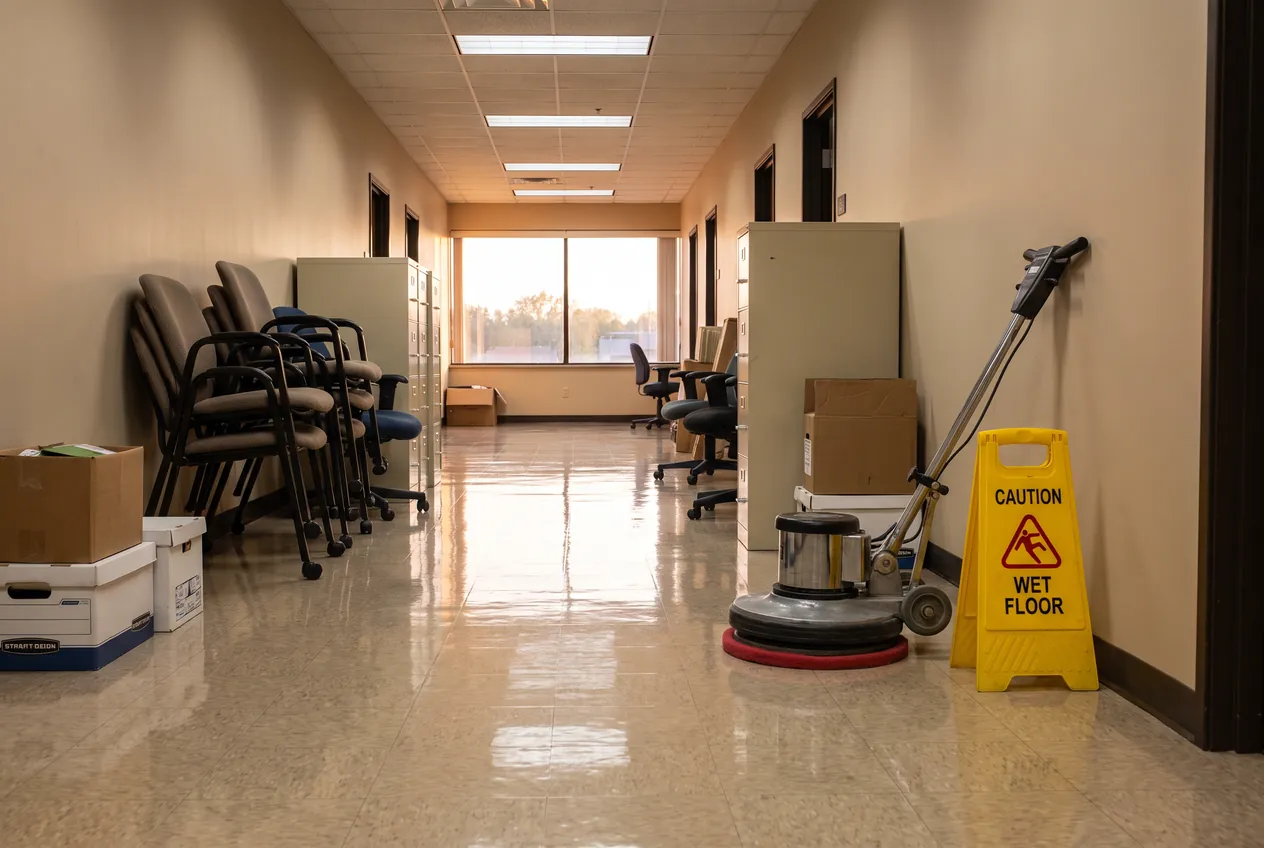
What strip and wax means today
The floor most often stripped and refinished in commercial buildings is VCT, or vinyl composition tile, the hard-wearing tile common in corridors, break rooms, clinics and retail aisles. The word wax has stuck around, but what goes down now is usually an acrylic floor finish rather than an actual wax. It protects the tile, gives it shine and takes the wear so the tile itself does not.
Over months of traffic, the finish gets scratched, embedded with grit and yellowed by layers of old coats. Stripping removes all of it down to bare tile so fresh finish can go on clean. That is why a strip and refinish makes such a visible change compared with routine mopping or buffing.
Step by step: how a crew strips and refinishes VCT
The process is the same in an office break room or a long clinic corridor. The time it takes depends mostly on the size of the area, how much old finish has built up and how many coats go back down.
| Step | What happens | Why it matters |
|---|---|---|
| Clear the room | Furniture, mats and anything on the floor is moved out | Stripper and slurry need open floor, and finish cannot go around objects |
| Dust mop | Loose grit and debris are removed | Grit gets ground into the tile and the new finish if left behind |
| Set out wet floor signs | Entrances to the work area are marked or closed off | A floor coated in stripper is extremely slippery |
| Apply stripper and let it dwell | Stripping solution is spread and left to soften the old finish | Rushing this step means more scrubbing and patchy results |
| Scrub | A low-speed floor machine with a stripping pad breaks up the old finish | Edges and corners are often worked by hand |
| Pick up slurry | A wet vacuum removes the dissolved finish and solution | Slurry left to dry hardens back onto the tile |
| Rinse and neutralize | The floor is rinsed, often twice, and neutralized | Stripper residue stops new finish from bonding properly |
| Apply finish | Several thin coats, often 3 to 5, with drying time between each | Thin coats dry harder and clearer than thick ones |
| Burnish later | A high-speed machine polishes the cured finish, if the program calls for it | Adds shine and helps the surface resist scuffs |
Floors that should not be stripped
Stripping is aggressive, and plenty of modern floors are not built for it. Many luxury vinyl tile and plank products and no-wax resilient floors have a factory wear layer that stripper can damage or cloud. Some manufacturers specify their own cleaner and say never to apply floor finish at all. Before booking any strip and refinish, find out what the floor is and check the manufacturer's care guidance.
If no one knows what was installed, ask the provider to look at it in person. A cleaning company with floor care experience can usually tell VCT from luxury vinyl, and will test a small hidden area before committing to a full strip.
- Luxury vinyl tile and luxury vinyl plank, unless the maker allows it
- No-wax sheet vinyl and similar factory-finished floors
- Floors still under a warranty that rules out stripping
- Any floor where the type is unknown and no test was done
Full strip or scrub and recoat
A full strip is not the only option. Between strips, many buildings book a scrub and recoat: the crew deep scrubs the top layers of finish without going down to bare tile, rinses, and applies fresh coats. It takes less time, uses less chemical and keeps the floor protected while the base layers stay intact.
Full stripping is often done yearly or twice a year, depending on traffic. A lightly used office floor may go a full year on scrub and recoats, while a busy clinic hallway, cafeteria or main entrance shows wear much sooner. Signs that a full strip is due include yellowing, dirt trapped under the finish, and finish that has worn through in the main walking paths.
Getting the building ready
Ventilation, slip risk and drying time are the reasons this work happens after hours or on weekends. Stripper has a strong odor, the floor is unsafe to walk on until the finish has dried, and foot traffic on soft finish leaves marks that stay until the next strip. Plan for the area to be closed for the full job, including drying time on the last coat.
Facility managers can help the crew finish on schedule by handling a few things before they arrive. Most delays on refinishing nights come from cluttered rooms, locked utility closets or staff who did not know the area was closed, and each of those is easy to prevent with a little notice.
- Clear desks, chairs and small items or confirm the crew will move them
- Tell staff which areas are closed and for how long
- Confirm access to water, a utility sink and a drain for rinse water
- Keep HVAC running so the area ventilates and the finish dries
- Agree on where mats and furniture go when the floor is done
Floor care in Louisville buildings
Louisville's wet, cold winters bring grit, slush and moisture onto entry floors for months, and that abrasive mix wears through finish fastest near the doors. Humid summers can slow the drying of finish coats, which is one more reason to give the crew a full overnight or weekend window. Many buildings find a spring scrub and recoat at the entrances worth adding to the floor plan.
Older downtown buildings may have original hard floors alongside newer tile, and those older surfaces often need different products entirely. In medical offices, which make up a large part of the local building stock, hallways and exam areas tend to need refinishing more often because of rolling carts and constant foot traffic.
What drives the cost of stripping and waxing
Strip and refinish work is usually priced by the square foot, but the rate moves with the condition of the floor. Heavy buildup of old finish takes longer to strip. A cluttered room adds time for moving furniture. More coats of finish mean more material and more drying time. Open, empty corridors go faster than offices broken into small rooms.
Access matters too. A crew that can work through a weekend without interruption is more efficient than one squeezed into a short weeknight window. Ask the provider to quote the full strip and any scrub and recoat visits as separate lines, so you can compare quotes on equal work.